In a nutshell
- 🔌 Electricians expose standby “vampire loads” from set‑top boxes, consoles, smart speakers, and microwaves—small wattage that runs 24/7 and quietly inflates bills.
- 🛁 Comfort culprits in plain sight: heated towel rails, dehumidifiers, wine coolers, and AV receivers in network standby can add a steady, costly draw if left unscheduled.
- 📊 Real measurements matter: pros use meters to reveal your home’s baseline load; if overnight draw sits around 150–250W or higher, you’ve likely got devices worth switching or reconfiguring.
- 🛠️ Practical fixes: disable quick start and enable deep sleep, fit timers on heating gadgets, use switched extensions and smart plugs, and right‑size aquarium pumps/heaters.
- 💷 Cost context: at roughly 28p/kWh, even an 8W router or a 12W DVR adds up annually—tackling the background hum delivers immediate, visible savings.
Across Britain, homeowners are fretting about bills yet overlooking some of the biggest energy thieves hiding in plain sight. Electricians I’ve spoken to in London, Leeds and Llandudno say the same thing: the true culprits aren’t always the appliances we run for hours, but the gadgets we barely notice at all. From the quiet standby glow of entertainment kits to comfort luxuries that tick over all night, tiny loads add up. The secret is persistence, not peaks. A device sipping a few watts can cost more than an appliance that blasts for minutes then stops. Here’s what professionals are finding when they put a meter where our assumptions used to be.
Silent Standby: The Hidden Loads You Can’t See
Ask an electrician which devices surprise clients most and you’ll hear a familiar list. Set‑top boxes left in “ready to record” mode. Games consoles parked in “instant on”. Smart speakers waiting for a wake word. Even the humble microwave, whose bright clock runs 24/7, can cost pounds each year to display the time. Standby is not zero. It’s a measurable, billable trickle known as vampire load, and it quietly drains money whether you’re home or not.
Routers and mesh nodes are another fixture. We expect the internet to be ever‑present, so the lights stay on. Individually, a good router might draw only 6–10W. Together—router, extender, hub—that’s a permanent footprint. Electricians also point to laser printers in “ready” mode, whose fuser stays warm, and doorbell chimes powered by old transformers that hum with wasted heat. Multiply those tiny losses across a household and the totals become uncomfortable.
What makes these loads sneaky is psychology. People tally the tumble dryer but forget the “always‑on” club. One engineer described a living room stack—amp, streamer, TV, HDMI switch—consuming 25W while “off”. That’s a light bulb burning all year. The fix is rarely dramatic: disable quick‑start features, choose “eco” modes, and use switched extension leads. The savings? Immediate and visible on a smart meter’s in‑home display.
Culprits in Plain Sight: Comfort Gadgets That Never Switch Off
Some devices don’t lurk in standby; they simply run. Heated towel rails are a classic British luxury that can become a constant draw, especially when fitted without timers. A modest 60W rail is like leaving a small panel heater on forever. Underfloor heating controllers, wine coolers and dehumidifiers set to “auto” can also nibble through kilowatt‑hours, because ambient conditions rarely give them a true rest. Small heaters are big bills when left unchecked.
Aquarium gear is another electrician’s eyebrow‑raiser. Pumps run continuously for fish health, and thermostatic heaters cycle to maintain temperature. That’s mission‑critical, but many tanks operate with oversized or poorly insulated setups. Likewise, old halogen security lights with ageing sensors can misbehave, staying warm and drawing power even when no one’s outside. Electricians often swap these for efficient LEDs with proven PIR sensors and tighter standby specs.
In media cabinets, AV receivers with “network standby” keep chips alive for fast control via apps. It’s convenient. It’s also a few watts, all day. The same goes for multiroom audio amplifiers and soundbars that never fully sleep. The practical advice from the trade is simple: schedule comfort, don’t default to forever. Fit timers to towel rails, use smart plugs for dehumidifiers during high‑humidity windows, and pick “deep sleep” where manufacturers offer it. Control is the difference between comfort and creep.
Data From the Fuse Box: What Electricians Actually Measure
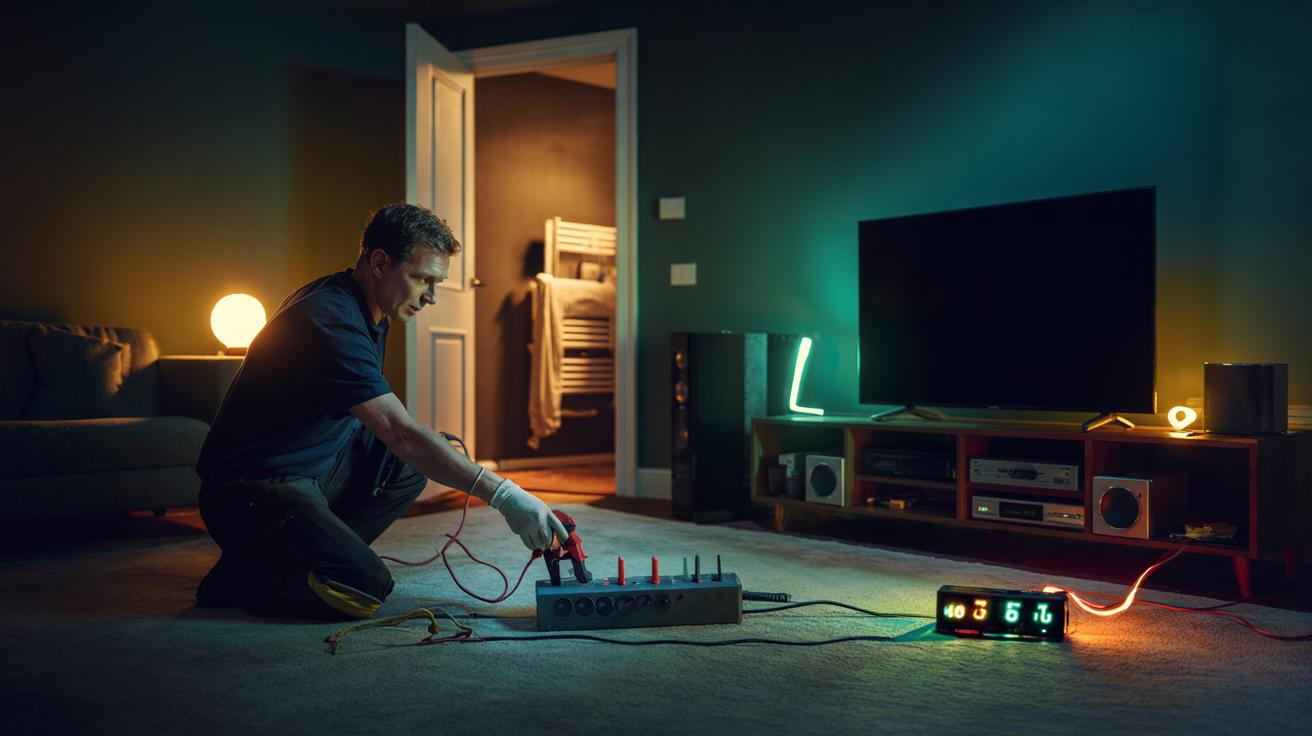
Professionals don’t guess; they meter. A plug‑in power meter or a clamp meter on a circuit reveals the honest numbers behind the mystery. Patterns emerge quickly: routers and set‑top boxes dominate baseline consumption; entertainment stacks contribute surprising standby; “always a bit warm” items like transformers and towel rails show up as steady bars on a load graph. Once you see your base load, you can shave it. To make the detective work easier, electricians often benchmark common devices against annual costs.
| Device | Typical Hidden Draw (W) | Annual Cost at 28p/kWh |
|---|---|---|
| Wi‑Fi router (single unit) | 8 | £19.62 |
| Set‑top box/DVR (record‑ready) | 12 | £29.43 |
| Smart speaker | 3 | £7.36 |
| Microwave (clock only) | 2 | £4.91 |
| Laser printer (ready mode) | 6 | £14.72 |
| Heated towel rail (unscheduled) | 60 | £147.17 |
These figures are illustrative; your tariff and kit will vary. But the principle stands. Baseline load is the bill you pay before you boil a kettle. Electricians recommend checking your smart meter’s overnight draw when nothing obvious is running. If it’s above, say, 150–250W in an average home, you’ve got suspects worth interrogating—one switch, one setting, one socket at a time.
How to Cut the Waste Without Losing Convenience
Start with settings. Disable quick start on consoles and set‑top boxes, choose “eco” or “deep sleep” on TVs and soundbars, and turn off “network standby” where you don’t need app control. For routers and broadband gear, consider slimming the mesh—one node off at night may suffice—but be mindful if your landline uses digital voice via the hub. Connectivity is vital; cut carefully.
Tackle heat. Fit a programmable timer or smart thermostat to towel rails and underfloor zones, aiming for targeted comfort windows instead of a 24/7 trickle. In damp rooms, run dehumidifiers during peak humidity, not continuously; many smart plugs offer energy charts so you can tune schedules to conditions. For aquariums, insulate tanks and lids to reduce heater cycling and choose efficient pumps that match the tank size rather than overspec models.
Finally, consolidate and switch. Use a quality, switched extension behind entertainment units so one flick truly powers down peripherals you don’t need overnight. Put printers on smart plugs that wake only when you print. Label chargers and power bricks you can live without between uses. The goal isn’t inconvenience; it’s intention. When every watt has a job, your base load shrinks—and your bill follows suit, quietly but reliably.
Electricians aren’t wagging fingers; they’re offering a map. The richest savings often come from the dullest places, and the fix is usually a setting, a schedule, or a better habit. Reduce your baseline and everything else gets cheaper. As bills yo‑yo and households electrify heat and transport, trimming the background hum becomes a form of insurance. Which device in your home will you test first—and what will the meter say when you finally catch it in the act?
Did you like it?4.5/5 (26)