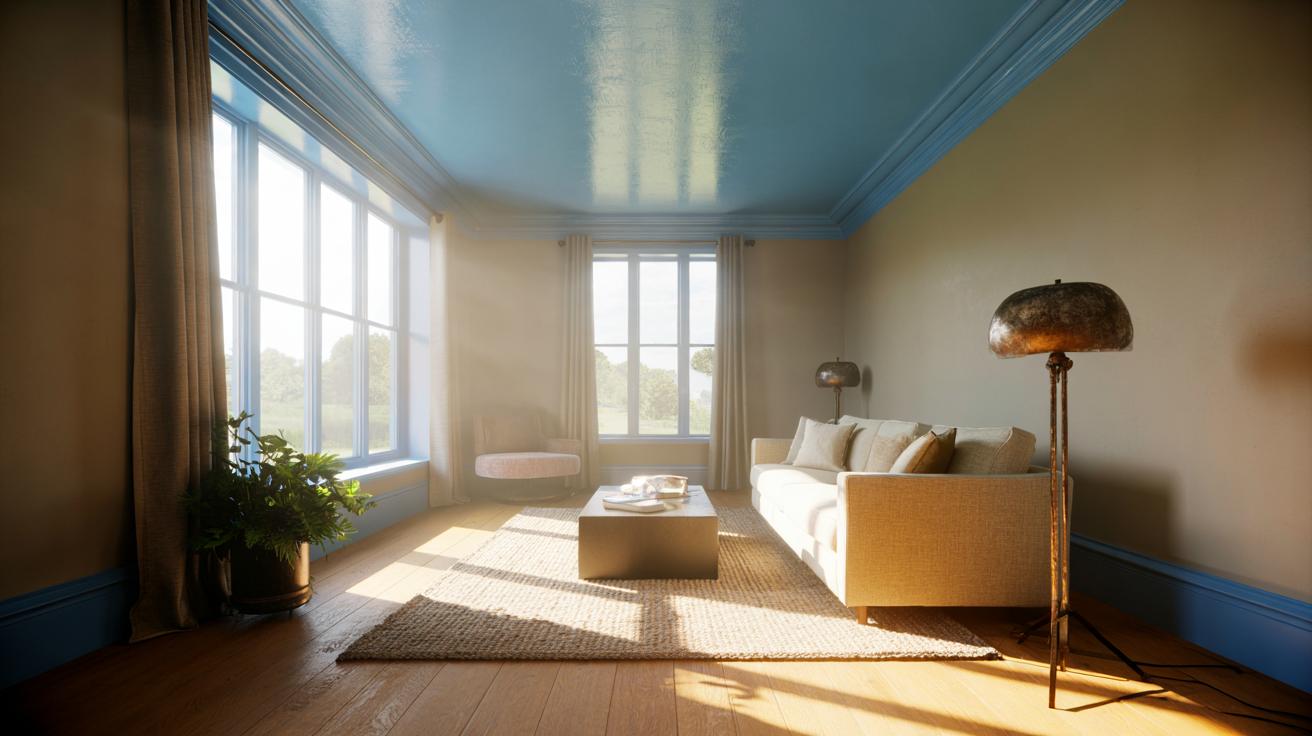
In a nutshell
- 🌤️ Painting the fifth wall a pale sky blue lifts the gaze, softens shadows and makes rooms feel taller, calmer and more deliberately designed.
- 🧠 The science: cooler hues visually recede and a balanced Light Reflectance Value (LRV 60–75) reflects light without glare, improving both height perception and mood.
- 🎨 Choose softly grayed blues (think “mist,” “powder,” “haze”) and pair finishes wisely—dead-flat matt hides imperfections; a subtle soft-sheen adds brightness in darker spaces.
- 🛠️ Architect tips: test swatches on the ceiling, drop the colour slightly onto walls or cornices and coving, use 2700–3000K bulbs, and consider low-VOC paints for healthier indoor air.
- 🏠 Room strategies: a sky-blue ceiling complements warm-neutral walls and natural timber; delivers room-by-room gains—from airy living rooms to restful bedrooms—on a modest budget.
Architects are calling it the simplest makeover you’re not using: paint your ceiling a pale sky blue. This gentle hue, once confined to seaside porches and historic halls, is quietly reshaping modern homes across the UK. Why? It lifts the gaze, softens shadows, and coaxes natural light across a room with surprising generosity. The effect is subtle but undeniable. Walls feel calmer. Cornices sharpen. Spaces breathe. In compact flats and lofty Victorian terraces alike, a sky-tinted “fifth wall” turns hard rectangles into rooms that feel open, serene, and deliberately designed. The best bit: the transformation costs little, and you can achieve it in a weekend with a roller and thoughtful prep.
Why Sky Blue Works on the Fifth Wall
The ceiling is often ignored, left default white or dulled by time. Treat it as a design surface, and the atmosphere changes instantly. A pale sky blue ceiling borrows from the outdoors, gently mimicking daylight and the illusion of sky beyond the roofline. Architects describe the psychological impact as de-stressing and spatially expansive: cooler hues visually recede, nudging the plane “away” from the eye, which makes rooms feel taller. It’s a soft trick of perception that reads as natural rather than theatrical. Unlike heavy pigments, airy blue doesn’t weigh down period plasterwork or contemporary shadow gaps; it clarifies them. Mouldings pop. Lighting feels less stark.
There’s cultural heritage, too. From Georgian stairwells to the folklore of “haint blue,” ceilings in soft blue have long suggested safety, openness, and fresh air. Today’s architects reinterpret that tradition with calibrated tones that sit between grey and aqua, allowing blue undertones to cool warm woods or temper pinker beiges. Crucially, the colour is not the protagonist; it’s a diffuser. As daylight shifts, the ceiling modulates from morning pearl to evening mist, lending rooms a living, breathing quality that plain white rarely achieves.
Light, Height, and the Science of Perception
Designers talk about Light Reflectance Value (LRV) because it governs how a paint behaves. For ceilings, a pale sky blue with an LRV around 60–75 reflects plenty of light while preventing glare. That matters under downlights and in north-facing rooms prone to grey casts. A cool tint neutralises yellowing from warm bulbs and creates a cleaner, more balanced envelope. The science is simple: cooler pigments recede; warmer pigments advance. Your eye reads the blue ceiling as further away, so the room seems taller. Simultaneous contrast also kicks in, making off-white or oatmeal walls appear fresher beside the blue plane.
Finish plays a role. A flat matt or ultra-matt knocks back ceiling imperfections and spreads light evenly; a soft-sheen can introduce subtle bounce for darker rooms but risks highlighting roller marks. Aim for minimal sheen unless you need reflectivity in deep-plan spaces. Edge handling is critical: take the blue fractionally down the top of the wall or into the coving to avoid a harsh cut line that visually “lowers” the room. With even a slim overlap, boundaries blur, and the ceiling drifts away pleasantly instead of sitting like a lid.
| Ceiling Colour | Spatial Effect | Light Behaviour | Mood | Best Rooms |
|---|---|---|---|---|
| Pale Sky Blue | Feels taller, airier | Softens glare, reflects evenly | Calm, open | Living rooms, bedrooms |
| Bright White | Neutral height | High glare under spots | Clinical | Kitchens, utility |
| Deep Navy | Cocooning, lower | Absorbs light | Dramatic | Dining, cinema rooms |
| Warm Cream | Cosy, slightly lower | Amber glow at night | Comforting | Snugs, cottages |
How to Choose the Right Shade and Finish
Not all blues are equal on the ceiling. Seek softly grayed shades with modest chroma; look for descriptors like “powder,” “mist,” or “haze”. If your walls skew warm (stone, taupe, mushroom), lean into a green-tinged blue to bridge temperatures. With cooler greys, a violet-leaning blue adds warmth without turning purple. Patch test large swatches directly on the ceiling, not the wall, and view across two evenings and a sunny morning. Light sources alter undertones. Tungsten warms; daylight cools. You want a tone that stays gentle, never babyish or icy.
Finish is about forgiveness and intent. A dead-flat matt disguises hairline ripples in older plaster; it’s the default for most homes. In low-light interiors, a soft-sheen (around 5–10%) can elevate brightness but demands careful rolling to avoid flashing. Consider tint strength too: if you love your wall colour, ask for a ceiling mix at 30–50% of that hue for a colour-drenching effect that still reads sky-like. Choose low-VOC paints to reduce odour and improve indoor air quality. And buy slightly more than you think; ceilings drink paint, and touch-ups look cleaner from the same batch.
Practical Tips From UK Architects
Preparation is half the result. Wash down, fill cracks, sand lightly, and prime stains so the blue reads true. When cutting in, drop the ceiling colour a few millimetres down the wall to soften the boundary, especially around cornices and coving. Architects often pair a sky-blue ceiling with warm-neutral walls and natural timber to balance cool and warm notes. In north-facing living rooms, switch bulbs to 3000K warm white; the ceiling will counter yellowing while keeping evenings cosy. In south-facing spaces, 2700K bulbs avoid a stark, clinical feel at night.
Plan lighting as part of the scheme. A blue ceiling loves wash lighting: wall grazers, shaded floor lamps, and linear LED coves that push light upward, letting the tint glow. For rentals or listed homes, this is a reversible, non-invasive upgrade that reads as bespoke. Styling is straightforward: linen, textured sisal, and oxidised brass complement the cool ceiling beautifully. If you have dark floors, the blue draws the eye up and rebalances weight. In open-plan flats, repeat the ceiling colour on a door or bookcase detail to stitch zones together without shouting.
| Room | Suggested Blue | Wall Pairing | Result |
|---|---|---|---|
| Living Room | Soft sky, greyed | Warm linen white | Airy, relaxed hosting |
| Bedroom | Blue with green hint | Oatmeal or mushroom | Restful, grounded |
| Hallway | Powder blue | Pale stone | Brighter circulation |
| Home Office | Blue-grey | Soft greige | Calm focus |
A ceiling in pale sky blue is not a gimmick. It’s a quiet recalibration that makes rooms kinder to live in and kinder to light, all while honouring architecture rather than fighting it. The transformation is fast, the cost modest, the effect long-lasting. Once you’ve seen a room “exhale” under a sky-tinted ceiling, stark white feels oddly unfinished. Ready to lift your gaze and change the way your home feels in every season—without moving a single wall? Which room in your home would you try first, and what shade of sky are you imagining above you?
Did you like it?4.4/5 (25)